How to Improve Brand Visibility in AI Search Engines
You've done everything your ecommerce checklist recommended. Product titles are clean, descriptions are written, images are optimised. And yet when a shopper opens ChatGPT and types "best organic collagen powder in Germany," your shop doesn't appear anywhere in the answer.
This isn't bad luck. It's an AI visibility problem — and knowing how to improve brand visibility in AI search engines is the first step toward fixing it.
The Challenge: AI Search Doesn't Work Like Google
Traditional SEO rewarded keyword placement: put the right terms in the right places, earn backlinks, and Google ranked you higher. AI assistants — ChatGPT, Perplexity, Google AI Mode, Microsoft Copilot — work differently. They don't match patterns. They reason.
When someone asks "what's the best magnesium supplement for sleep?", an AI synthesises answers from everything it has learned and currently accesses. It looks for sources that are trustworthy, well-structured, and rich with specific, factual context. Most Shopify product pages don't meet those criteria — not because they're poorly written, but because they were designed to persuade a human reader, not to inform a machine.
The numbers make this urgent. AI referral traffic to e-commerce sites grew 357% year-over-year in 2025. Nearly 60% of Google searches now end without a click, as users get answers directly from AI-generated summaries. The question isn't whether to care about AI visibility — it's whether you can afford to keep ignoring it.
How to Fix It: A Step-by-Step Approach
There are proven techniques for boosting visibility in AI search algorithms — but applying them manually requires a real investment of time and technical skill. Here's what the full process looks like.
Step 1 — Start with an ecommerce SEO audit
Before making any changes, run a proper ecommerce SEO audit focused specifically on machine readability. Ask: does each product page explain what the product does, who it's for, and how real people use it — in plain, specific language? Check whether you already have schema markup in place by running your URLs through Google's Rich Results Test.
Step 2 — Add structured data to your product pages
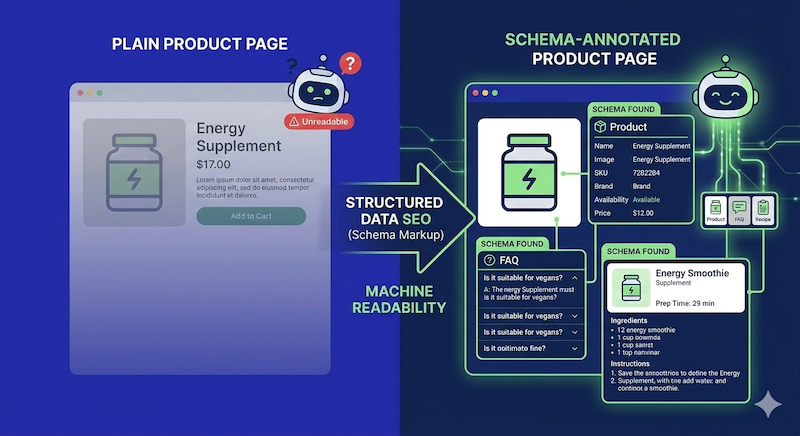
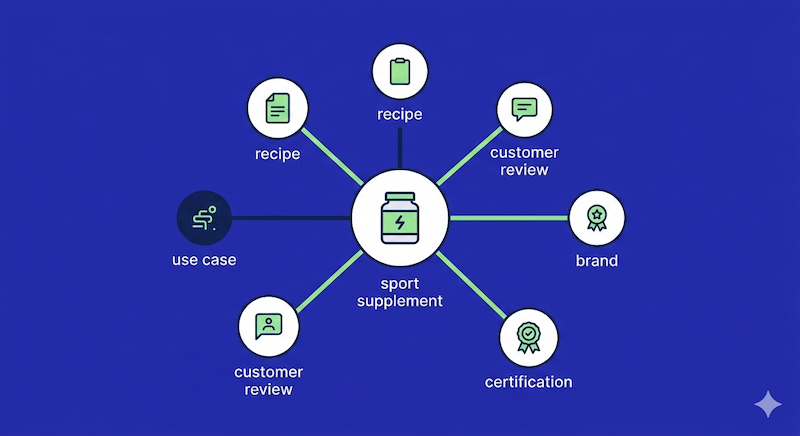
Structured data (schema markup) is the technical layer that makes your content machine-readable. A Product schema tells AI crawlers: this is a Product, here is its name, brand, ingredients, use cases, and reviews. Without schema, an AI system has to guess what your page is about. With it, it can cite you with confidence. Start with Product, FAQ, and Recipe schemas — these three have the highest direct impact on AI discoverability.
Step 3 — Write explicit use-case content
AI systems are trying to match products to situations, not just keywords. Research from e-commerce case studies shows that product pages with a dedicated "Use Cases" or "Who is this for" section attract the majority of AI-driven traffic. Be specific: not "great for wellness" but "used by adults recovering from high-intensity training and by people with difficulty sleeping."
Step 4 — Learn how to track brand mentions in AI search
Once you've made changes, you need to know whether they're working. How to track brand mentions in AI search is not obvious — standard analytics won't show you this. Dedicated monitoring tools run your brand queries across ChatGPT, Perplexity, and Google AI Mode using neutral API connections, so you see what the average user sees rather than personalised results. Many shop owners ask: is it possible to track brand mentions in AI search reliably at all? Yes — but you need purpose-built tools. Look for the best AI search monitoring platforms that run the same prompt repeatedly (typically 50–100 times) to account for model variability before reporting your share of citations.
Step 5 — Build external credibility signals
AI systems don't just read your product pages — they synthesise signals from across the web. Products mentioned in recipe blogs, specialist review sites, and how-to posts receive more AI citations. The best ways to improve brand visibility in AI search results therefore extend beyond your own website: proactive digital PR, getting your products featured in authoritative third-party sources, is as important as anything you do on-page.
The Easier Solution: Kombiq Does This For You
All of the above is real, necessary work. The challenge is that it requires technical expertise, ongoing monitoring, and consistent content production — resources most small shop owners don't have.
That's exactly what Kombiq is built for.
Kombiq starts by generating a free AI Visibility Score for each of your products. It crawls your Shopify store, builds a knowledge graph from your existing content, and compares your product data against industry leaders in your category. You receive a per-product score and a clear action plan — not a vague dashboard.
From there, Kombiq generates the schema markup, enriches your product pages with use-case content drawn from your own reviews and social posts, and builds the structured foundation that AI tools rely on when deciding what to recommend. Think of it as your complete AI strategic visibility solution — one that fixes the root cause rather than just measuring the symptom. See how it works →