What Is a Knowledge Graph? A Guide for Shopify Stores
If you've been reading about knowledge graph SEO and wondering whether it applies to your shop — it does. In fact, it may be the single most important thing you're not doing yet.
This article explains what a knowledge graph is, why structured data is the language AI uses to understand products, and how to build this infrastructure for your shop without a developer.
The Challenge: AI Can't Understand Unstructured Product Pages
Your product pages were designed to persuade a human reader. A human can glance at a photo of your cacao powder, read "100% organic, raw, stone-ground," and mentally connect it to "great for my smoothie bowl."
An AI system cannot make that leap — unless you give it explicit structure.
Many shop owners ask: why is my website not showing up on Google AI answers or ChatGPT responses, even though the content is solid? The answer is almost always the same: AI systems lack the structured knowledge layer they need to recommend your products with confidence.
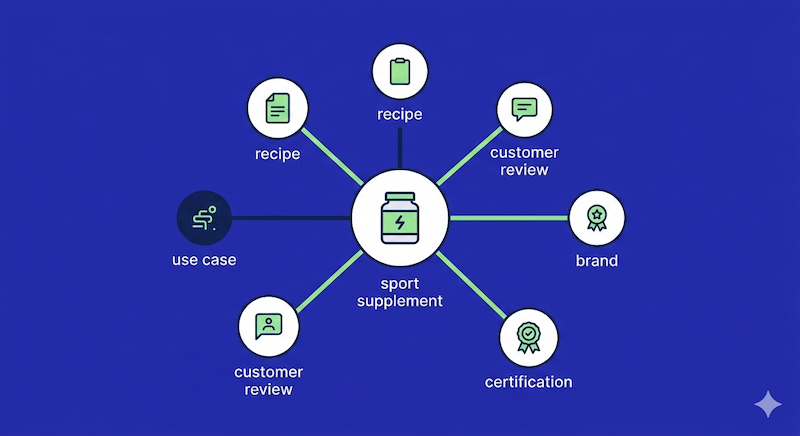
So what is a knowledge graph, exactly? In plain terms, a knowledge graph is a structured map of your product and everything connected to it: its ingredients, use cases, preparation methods, target customers, related recipes, customer testimonials, and certifications. It's the difference between your product existing as a webpage and existing as a machine-readable entity that AI systems can understand, cite, and recommend.
Without this, your shop may have great products and excellent content — and still be effectively invisible to AI search.
How to Build a Product Knowledge Graph: Step by Step
Step 1 — Map your product's facts explicitly
For each key product, write down: what it is (category, ingredients, certifications), what it does (properties, benefits, flavour profile), who uses it (customer types, dietary needs), and how it is used (recipes, preparation, pairings). Be specific: not "healthy snack" but "high-protein, low-sugar snack for athletes and active adults, suitable for ketogenic diets." This written knowledge base becomes the raw material for your schema markup and forms the foundation of your knowledge graph.
Step 2 — Understand what schema SEO is and implement it
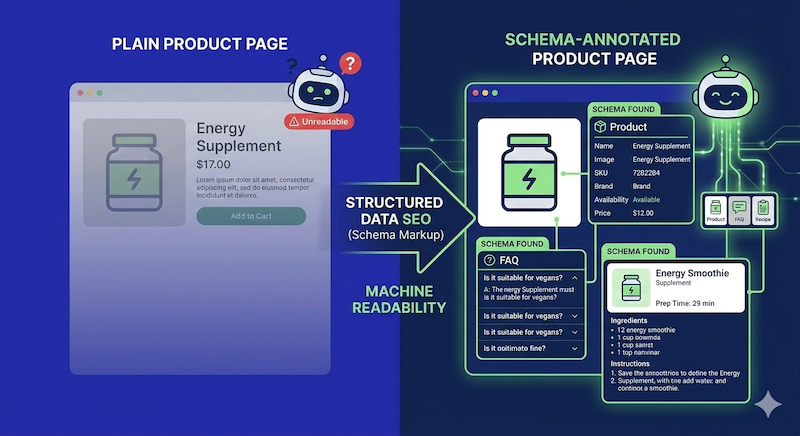
What is schema SEO? It's the practice of embedding structured data into your pages using JSON-LD — a standardised vocabulary that tells AI crawlers exactly what type of content each page contains. Key schemas for e-commerce include: Product (name, brand, price, availability), Recipe (ingredients, instructions, dietary tags), and FAQPage (question-and-answer pairs that AI can cite directly). Use a schema markup generator to produce valid JSON-LD without writing code. Always validate your output with Google's schema markup validator before publishing.
Step 3 — Audit your structured data for errors
Even correctly written schema can fail silently due to syntax errors, missing required fields, or improper nesting. Start with the free Google Rich Results Test to check individual pages. For deeper coverage across your entire catalogue, a dedicated technical SEO audit service will surface problems that free tools miss — things like Product schema lacking the required "offers" field, or FAQ schemas not correctly associated with the product they describe.
Step 4 — Add a "Use Cases" section to every product page
This is the single highest-impact change most shop owners can make. Structure it explicitly: "This product is used for A, B, and C by people who need X." AI systems are matching products to intent, not just keyword queries — and this section gives them the semantic bridge they need to confidently recommend you.
Step 5 — Connect your graph to external authority sources
A knowledge graph doesn't exist in isolation. Link your product pages to certifying bodies, ingredient reference sources, and external content that discusses your products. This external entity linking is what completes a genuine structured data SEO strategy — one that compounds in authority over time, rather than staying static. It's also what separates a basic product schema from a content knowledge graph that AI systems genuinely trust. See how Kombiq builds this →
The Easier Solution: Kombiq Builds Your Knowledge Graph Automatically
Building a knowledge graph manually requires schema writing, technical SEO audit work each time your catalogue changes, and ongoing maintenance most shop owners simply don't have time for.
Kombiq does this automatically. When you connect your Shopify store, Kombiq crawls your product pages, reviews, manuals, and social posts. It builds a structured knowledge graph for each product, generates JSON-LD schema markup, and embeds it directly on your pages. AI crawlers can immediately understand what your product is, who it's for, and why it's the right answer to a shopper's question.
Kombiq also identifies gaps in your knowledge graph by comparing your product data against top competitors in your category. You see exactly which use cases, certifications, or entity connections are missing — and can generate content to fill them in one click. See all benefits →